


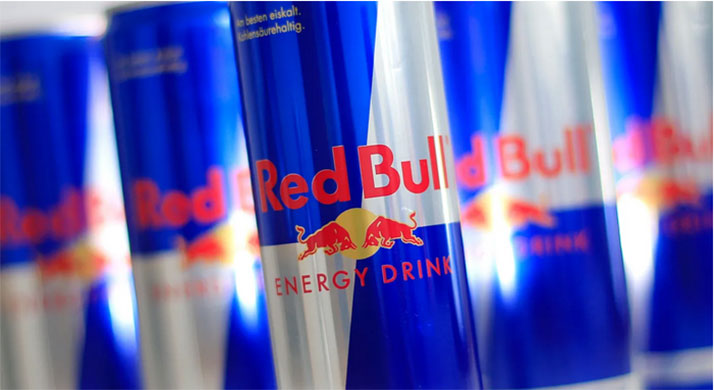
15 Jun 2025 Red Bull: the thing with wings
Forget jingles and TV spots – this is how Red Bull built an empire by selling a lifestyle disguised as an energy drink. …
With over two-thirds of the energy drink market in a vice grip, Red Bull isn’t just a beverage – it’s the undisputed overlord of its category.
But what does any of this have to do with death-defying stunts, football teams and the youngest Formula 1 driver in history? Welcome to perhaps the best example of lifestyle marketing in the world.
As of 2024, Red Bull was estimated to have a 37% share of the energy drink market, making it the most popular energy drink on the planet and the third most valuable soft drink brand behind Coca-Cola and Pepsi. Not bad for something that tastes like fizzy cough syrup and ambition!
Since crash-landing into the world in 1987, Red Bull has sold over 100 billion cans globally. 12.7 billion of those were sold in 2024 alone. That’s a lot of people hoping to sprout some wings.
The original formula came in exactly one flavour, but these days, there’s a rainbow of spin-offs and even a sugar-free option. But the core product remains a sort of carbonated rite of passage for students, startup founders, and anyone whose sleep schedule is a suggestion, not a rule.
The now-iconic slogan, “Red Bull gives you wings”, has been imprinted on the cultural psyche with the same permanence as “Just Do It” or “I’m Lovin’ It.” But Red Bull didn’t climb to the top by playing it safe. Instead, it built a high-octane mythology around itself, sponsoring death-defying stunts, adrenaline-fuelled sports, and events that blur the line between brand and belief system.
From jet lag to jet fuel
Before Red Bull was fuelling snowboarders, DJs, and sleep-deprived students in the West, it was keeping truck drivers and factory workers upright in the sweltering heat of Thailand. Its origin story takes us to the backstreets of Bangkok, where a duck-farmer-turned-pharmaceutical-entrepreneur named Chaleo Yoovidhya was tinkering with a solution for exhaustion.
Chaleo, the son of Chinese immigrants, founded T.C. Pharmaceutical Industries in the 1970s, selling over-the-counter syrups and medicines to Thailand’s working class. Inspired by Japan’s growing market of functional tonics, he created Krating Daeng in 1976 – a thick, non-carbonated, caffeine-and-taurine cocktail served in squat little glass bottles. It didn’t fizz, it didn’t come in a designer can, and no one called it a “lifestyle choice.” It was made for people who worked long, hard hours and needed to stay awake to finish them.
And that might’ve been the whole story if an Austrian toothpaste marketer hadn’t been battling jet lag in the early 1980s.
Enter Dietrich Mateschitz
On a business trip to Asia, running on fumes and frustration, Mateschitz was handed a bottle of Krating Daeng by a local colleague. One sip and his circadian rhythm snapped back like a rubber band. More importantly, he saw something others didn’t: a business opportunity with wings.
By 1984, Mateschitz and Chaleo had struck a deal. They co-founded Red Bull GmbH, each owning 49%, with 2% set aside for Chaleo’s son, Chalerm. Chaleo brought the formula. Mateschitz brought the vision, and the rest, as they say, is history.
But bringing Krating Daeng to the West wasn’t a copy-paste job. Western palates weren’t ready for the syrupy, medicinal original.
So Mateschitz carbonated it, tweaked the sweetness, and ditched the humble glass bottle for a slim, futuristic can that looked more at home in a nightclub than a 7-Eleven. From the packaging to the flavour, it was a complete identity overhaul – but the masterstroke would be the positioning.
In Thailand, Krating Daeng was a blue-collar tool. In Europe, Red Bull would be an elite accessory. A drink not for the tired, but for the tireless.

An empire of experiences
Instead of sticking to traditional ads or celebrity endorsements, Red Bull built its identity around experiences – specifically, the kinds of experiences that involve risk, speed, or gravity-defying stunts.
Its strategy is rooted in experiential marketing. The idea is that people remember what they feel, not just what they see. By sponsoring extreme sports events and athletes, Red Bull has created a strong association with adrenaline, ambition, and adventure. To keep that storytelling in its own hands, Red Bull created Red Bull Media House, an in-house content studio responsible for everything from YouTube videos and Instagram reels to documentaries and podcasts.
By keeping production close to the brand, it ensures consistency in tone and message, something that’s helped Red Bull stay culturally relevant across platforms.
One of the clearest examples of this strategy in action is the Felix Baumgartner stratosphere jump, a moment that blurred the lines between science, sport, and spectacle……
GhostMail: Read the full article here
Related reading:

OBITUARY: Dietrich Mateschitz, founder of the Red Bull empire
Dietrich Mateschitz, the Austrian man who turned a caffeinated Thai energy drink into the multibillion-dollar Red Bull empire, died on Saturday October 24, 2022. He was 78.