


17 Jan 2026 Why we drink too much
What neuroscience and biology say about alcohol — and why the New Year is a natural moment to ask better questions.…
After a long and possibly overindulgent holiday season, a lot of us are trying a Dry January, or at least rethinking our relationship with booze. This is the time of year when we might notice how much alcohol has woven itself into our social lives, our stress management, our celebrations.
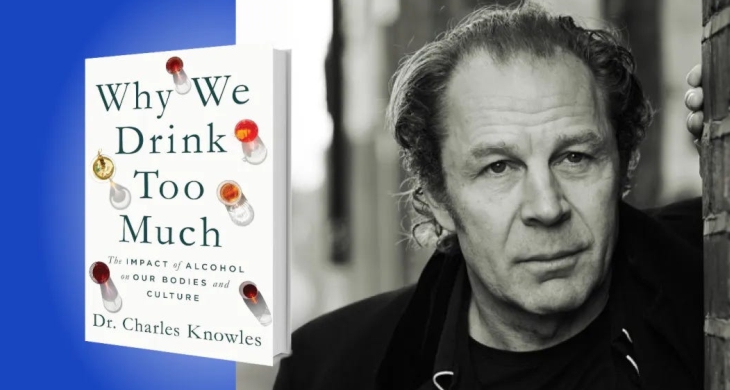
Charles Knowles is a Professor of Surgery at Queen Mary University of London and Chief Academic Officer at the Cleveland Clinic London, has a new book is called Why We Drink Too Much: The Impact of Alcohol on Our Bodies and Culture.
In this interview, he explains why problematic drinking isn’t defined by how much we consume, and what we really need to know if we want to change our relationship with alcohol.
1. Why do humans consume alcohol?
A necessary starting point to understanding why some humans drink too much is understanding why humans consume alcohol at all.
Our hominid ancestors evolved to metabolise alcohol over 10 million years ago, pushed by the need to safely consume rotting fruit from the forest floor. We have been deliberately manufacturing alcohol for over 15,000 years, and today it remains our most popular drug, despite many well-acknowledged downsides.
Why do we continue to drink it? We can’t still claim this as a nutritional necessity.
The vervet monkey on the island of Saint Kitts in the Caribbean is one example of many animal species that consume alcohol, with individuals showing variable enthusiasm for doing so. This attests to a fundamental biological driver. It cannot simply come down to clever advertising, peer pressure, or the price being right at the liquor store.
The brain lies at the heart of this. If we ask most people, they will tell us that drinking alcohol makes them feel good and that they have fun drinking it.
This is because alcohol is a primary reward; it can chemically alter the levels of certain neurotransmitters in our brains. The combined effects of alcohol on dopamine, but also on endorphins and GABA, lead to psychostimulatory and relaxant effects, in fact, mimicking the effects chemically of cocaine, opioids, and Valium.
It is these positive effects of alcohol on the brain that are the fundamental basis of why we and other animals consume alcohol.
2. The drinking scales
Although some people may find it hard to resist, ultimately, we consciously choose to drink. This is a cognitive process that takes information from our senses — the time of day, where we are, who we are with — and processes this information against what we know, using our ability to think intelligently before acting.
The positive effects we get from drinking are based on alcohol’s psychostimulatory and relaxant effects. We then come to balance these pros against the common negative effects (hangover, cost, embarrassment, etc).
This balance of the pros and cons is what Knowles calls the drinking scales. Everyone has a slightly different balance depending on their positive and negative experiences of alcohol. And this balance changes throughout life with societal norms and values.
If the drinking scales worked perfectly to provide a logic-based decision all the time, I wouldn’t be writing this book, he says.
The problem is that all around us are people for whom the evident harm of drinking should have been sufficient years ago to outweigh any positives, but still they drink. In such people, we can think of the scales as being broken or by-passed.
This happens because the brain is wired to allow it to happen. Survival programs deep in the ‘old’ parts of our brain, based around the reward pathway and memory, promote behaviour that once aided our survival in the jungle but which now leads to serious consequences rather than any useful purpose.
This is the basis of addiction. The question then becomes: why does this happen to some people and not to others?
3. Problematic drinking is not defined by how much we consume
“Why can’t he drink like a normal person?”, we hear this said. Many people see problematic drinking as a black-and-white issue. There are normal drinkers, and then those who have a problem. But there is quite a lot of gray.
The term gray area drinking has now become popular in community groups. But what do we mean by this compared to medical terms like alcohol dependence or alcohol use disorder?
Knowles recommends that anyone reviewing their relationship with alcohol should look at what he calls the three Cs: consumption, consequences, and control.
While long-term consumption level may have some important ramifications for health or finances, consequences and control are much more important angles for looking at the problem.
Consequences from alcohol range from common downsides (like a hangover) through to serious harms (car accidents, criminality) and chronic health problems affecting the body and brain.
Control, however, is perhaps the most important. After all, if we could control our consumption, we could just stop when consequences started occurring. And this brings us back to considering a spectrum where white might be neutrality, a “take it or leave it” approach to drinking, and black is dependence. But what then is gray?
He defines gray area drinking as someone who relies on alcohol in a way that is making them concerned about the amount they consume and their ability to control it.
And it brings in a new concept called alcohol reliance, a state of mind where consumption of alcohol has become a regular habit that is hard to give up, but has not yet led to the behaviours that define alcohol dependence.
4. Then there are bad genes and bad luck…. listen to this podcast to learn more…

ISource: Book of the Day