


25 May 2026 Ever more reason to trust SANBWA-accredited waters
As South Africans lose confidence in municipal water and alternative water products flood the market, SANBWA is making the case that responsible bottled water from verified source to sealed, traceable product is more important than ever. And more complex than most people realise.
Water is South Africa’s most essential and its most contested resource. Municipal infrastructure is failing in cities and towns across the country. Public trust is eroding. And into that vacuum, a growing number of water products have entered the market, not all of them safe, regulated or honest about what they are.
When the taps are dry, the need for a drinking water alternative forces the public to put their trust into products that might not be trustworthy.
The SA National Bottled Water Association (SANBWA) argues that this massive growth in unregulated packaged water makes the story of responsibly-bottled water more important to tell, not less.
It begins, as all water stories do, in the ground.
Where it starts
The Tulbagh valley in the Western Cape sits beneath mountains that have been filtering water through rock and earth for millennia. It is here that Thirsti, a SANBWA-accredited bottled water producer, has built a world-class new production facility. and it’s here that hydrogeologist John Weaver has spent time studying what makes a water source worth protecting.
Weaver is direct about the stakes. South Africa’s water systems are under pressure from over-extraction, poor infrastructure and growing demand. A good rainy season, he notes, does not fix a broken system.
What matters is whether a source is understood, monitored and managed for the long term and whether the science backs the claims made about it.
“Water is part of a living system. You cannot separate the bottle from the catchment that filled it. Understanding recharge rates, extraction limits and long-term source health is the foundation of everything that follows,” he says.
“South Africa is facing real water pressure, and that makes responsible source stewardship more urgent, not less.”
SANBWA requires every prospective member to submit a report from a qualified hydrogeologist confirming that their source is sustainable and protected from contamination. Without it, membership is not granted.
What happens next
Once water leaves the source, it enters what is, legally and practically, a food-production environment.
Thirsti’s new Tulbagh facility – purpose-built and representing significant capital investment of some R300m – illustrates what that actually means: controlled zones, continuous source monitoring, validated treatment processes, hygiene protocols, batch testing and a traceability system that can follow every bottle back through the supply chain.
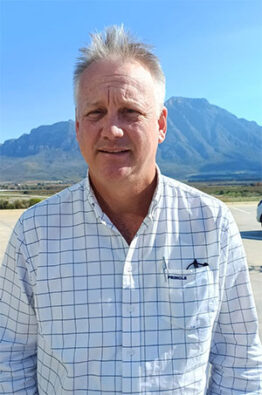
Thirsti CEO Rob Hoatson (left) is clear that this level of discipline is not incidental: “Anyone can put water into a bottle. The real question is whether you can prove where it came from, how it was handled, what standards were applied and whether the product can be traced if something goes wrong.
“That proof requires serious investment in equipment, systems, people, testing and audits. It is not something you can shortcut your way to, and it is exactly why standards matter.”
The wider problem
The rigour required to produce accredited bottled water stands in sharp contrast to what SANBWA describes as a growing grey market.
Refill stations are proliferating across SA, many pre-filling, sealing and labelling bottles for retail sale. This is a practice that legally constitutes packaged water production, and that triggers food-safety obligations most operators are not meeting.
The risks are concrete: no verified source, no batch testing, no traceability, no validated shelf life and no recall system if a product causes harm.
At the same time, misleading environmental claims, including bottles labelled “compostable” or “biodegradable” that cannot be processed by any infrastructure currently available in South Africa, are adding confusion for consumers trying to make responsible choices.
SANBWA CEO Charlotte Metcalf says the association’s role is to make the difference visible for consumers to be able to make an informed choice and to push for consistent enforcement of standards that already exist in law.
“When a consumer picks up a bottle of water, they should not need a science degree to know whether it is safe. That is what the SANBWA logo is for.
“It means a qualified hydrogeologist has verified the source, the facility has been independently audited, the product has been batch tested, there is a traceability system in place if anything goes wrong and that the plastic bottle is 100% recyclable.
“Water sold to the public must be safe, traceable and legally compliant. We will keep making that case until the standard becomes the norm.”
SANBWA member brands, including All Aqua, Aquabella, AquaMonte, aQuellé, Bené, Bonaqua, Designer Water, La Vie De Luc, Thirsti and Valpré, each carry the SANBWA logo as evidence of independently audited compliance with that standard.
Source: SANBWA