

29 Jun 2025 Another technology wins approvals to clean label sugar reduction
Here’s news of another tech way to sugar reduction for natural beverages – and which has both GRAS status for the US and EU approvals, too….
Israeli food tech company, BlueTree Technologies, reports that beverages processed using its ultra-filtration system can be marketed across the EU without requiring prior regulatory approval.
“Our technology gives natural beverage producers a powerful tool to reduce sugar content while preserving the natural taste, and now we can confidently bring that value to European brands and their consumers around the world,” says Michael Gordon, CEO at BlueTree Technologies.
The regulatory clarity also aligns with the upcoming EU juice labeling rules. Once the updated fruit juice regulations come into effect, beverages produced using BlueTree’s process that meet the criteria may be eligible to carry the legal designation of “reduced-sugar fruit juice.”
The startup is one of several food tech firms seeking to cut sugar in juice, with approaches ranging from enzymatic treatments that convert sugars to fibres (Better Juice – and much reported on by DRINKStuff SA) to microbes that eat the sugar (IncreBio).
So how does it work?
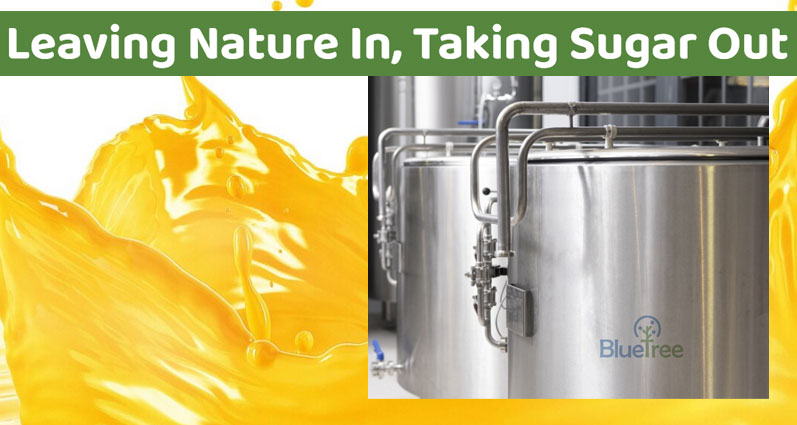
A plug-and-play selective sugar removal solution, BlueTree’s FDA-approved, patented physical separation technology combines multiple techniques to remove specific sugar molecules from natural drinks, like juices and milk, significantly reducing sugar while preserving essential nutrients, natural sweetness, texture, and taste.
The basic premise behind the tech is that disaccharides (sugar molecules comprising two simple sugars) such as sucrose (made from fructose and glucose) and lactose (made from galactose and glucose) are not as sweet as monosaccharides (simple sugars such as glucose and fructose), says Gordon.
As a result, removing 30% of the sugar in a juice through removing disaccharides does not necessarily make a beverage taste 30% less sweet, he notes. “It’s not a linear effect, so if you cut it by 30%, it tastes more like 15% because fructose [the simple sugars remaining in the beverage] are sweeter than sucrose. And with a 20% sugar reduction using this approach, you won’t even notice a difference.
“So the question was, how do we remove the disaccharides but leave the monosaccharides and other things in the juice intact?
Blue Tree’s first patent describes a two-step process, he explains. “The first part is ultra filtration and the other part is an adsorption process. We found out the mineral zeolite acts like a magnet to disaccharides in juice [sucrose] vs monosaccharides and organic acids.”
Ultra-filtration will enable a certain level of sugar reduction, but there’s a limit, says Gordon. So companies such as Fairlife may use it to remove some lactose from milk, for example, but they still have to add enzymes (lactase) to break down the remaining lactose into simple sugars.
“We have a second patent [pending] that explores an alternative separation technique, not involving zeolite, combined with ultra-filtration. Both methods offer flexibility in application. But we emphasize that throughout the sugar reduction process, including acidity adjustment, we do not introduce any external ingredients. This ensures a clean label and maintains the natural integrity of the juice.”
‘We’re not recommending taking out all of the sugar’
The Blue Tree system enables firms to cut significant amounts of sugar, but given that sugar impacts mouthfeel as well as sweetness, Gordon says firms need to find the right balance.
“So in orange juice 50% of the sugar is disaccharides, so we can cut total sugar by 50%. In pineapple juice it’s 60%. In milk, we’re able to remove 75% of the sugar, while in beer, we’re able to take out all of it, so we can create zero-sugar beer.”
But he adds: “We’re not recommending taking out all of the sugar from these beverages. Our first recommendation is typically 30%, although the ability to take out more is there.”
When it comes to sweetness, he says, part of our perception of this is through aroma. “When you smell the juice [that has gone through Blue Tree’s treatment], it has the same smell. So it doesn’t feel like the juice has been diluted.”
However, once you get to a 50% sugar reduction in an orange juice, for example, there will be perceptible differences in mouthfeel, he says.
Labelling
According to Gordon, labelling may “differ from one territory to another. In the US, for juice, as long as you’re using 100% natural juice and you’re not adding anything, you’re just removing the sugar, you can label it as 100% juice. In the EU, currently, juice that has gone through our process cannot be labelled as juice, but rather as a drink or a beverage.”
However, this looks set to change under the proposed ‘breakfast directives,’ which would permit terms such as ‘reduced-sugar fruit juice’ provided nothing has been added to the juice*, he notes.
The business model
According to Gordon, “We offer a leasing model. It’s a turnkey solution, but it takes us no more than two months to fully integrate our system into a partner’s manufacturing line. Once the system has been fully integrated, we charge a service fee to handle everything. So for example, the system needs consumable replacements every once in a while, so we handle it. But the day-to-day maintenance is very straightforward [and can be handled by the operator].”
Down the road, he says, “We see our customers as partners, so we aim to charge royalties, because there’s a lot of developments and added features that we can add in the future. As an example, some juice manufacturers are not working with just one fruit, and they’re looking to vary sugar reduction levels, so they could have a portfolio of sugar-reduced products.”
Manufacturers can also generate revenue from the sugar that is removed from the juice, he notes. “They can reuse it for other purposes in their operations, for example if they make lemonade, where you need to add sugar, or sell it to other industries.”
Consumers want less sugar… and a clean label
While per capita consumption of juice has been falling in some markets — a trend that was temporarily reversed during the early weeks of the COVID 19 pandemic when shoppers guzzled OJ in an effort to shore up their immune systems — consumers are looking for lower-sugar options across the beverage set, says Gordon.
But they also want natural, less processed, clean label products, and Blue Tree can deliver both. “We see our approach as a no brainer if products can still be labelled as sugar reduced 100% juice; you still just have one ingredient on the ingredients list.”
He adds: “What our partners appreciate about our team is that we come from the industry, so we know how to approach manufacturers and provide them with a very agile solution, which is very important, as manufacturers, especially in the beverage industry, can be very conservative.”
BlueTree is working with global beverage manufacturers to scale and reintroduce healthier, natural beverages into everyday consumer lifestyles, meeting the growing demand for high-quality, sugar-reduced options.
Backed by OurCrowd, Sucden Ventures, Fresh Start, Tnuva, NevaTeam Partners, Ratio Technologies, and the Israel Innovation Authority, BlueTree has raised $5.6-million.
Source: BlueTree, AGFunder.com